Blog
How to Make Playing Cards: Design Your Own Custom Deck
Learn how to make playing cards that work in play: readable indices, consistent court cards, one shared back and a practical review of the whole deck.
TCGPrintery4 min read
To make playing cards that work in play, set a visual rule for the whole deck, keep every rank and suit index readable and design one back that belongs to every front. A custom playing-card deck works best when its illustrations and its everyday playing functions support each other. A beautiful court card still needs a readable rank. A striking back should belong to the whole deck. The design challenge is to create a visual language that survives repetition across every card.
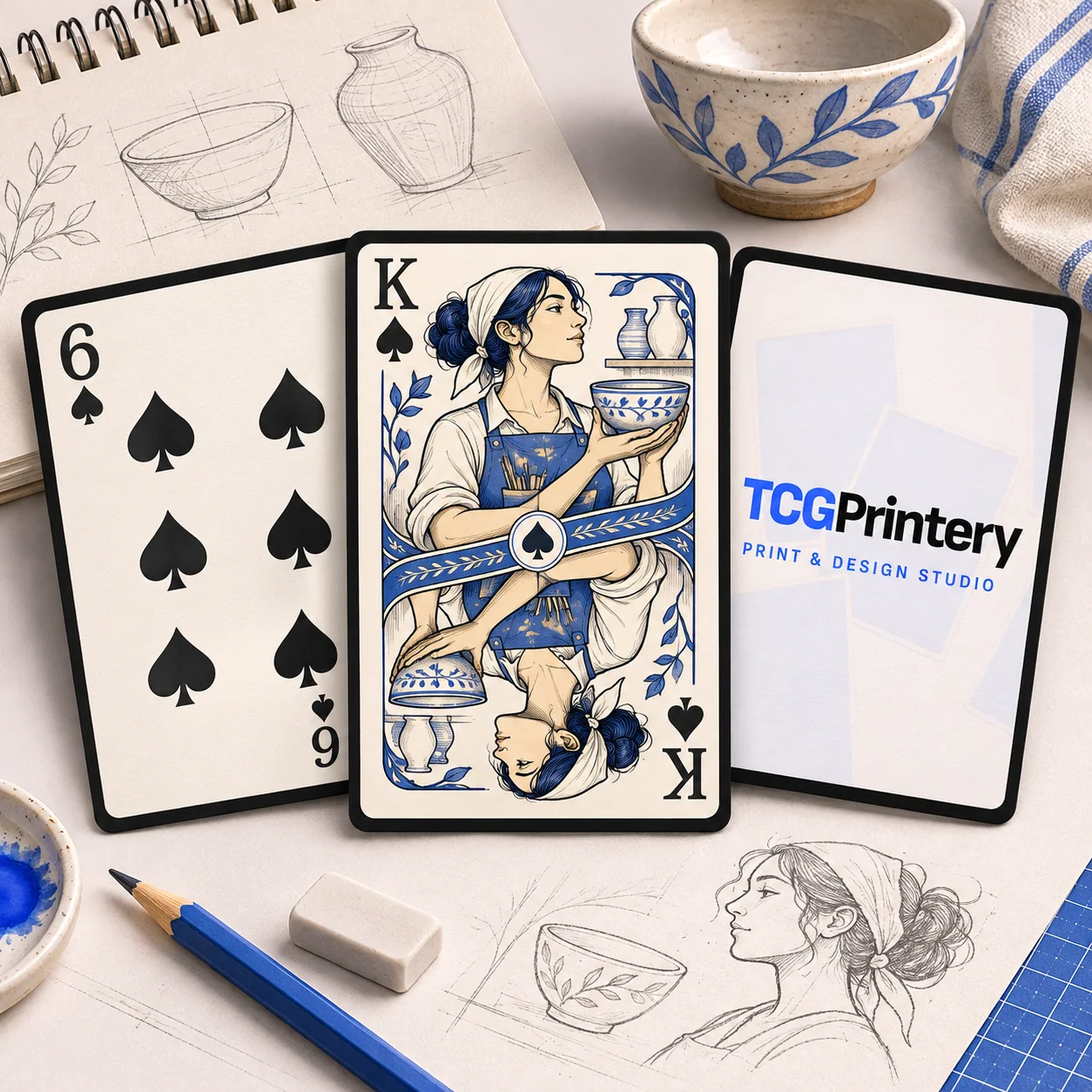
Our original example, Workshop Quartet, uses four creative trades as the inspiration for a conventional playing deck. Its court illustrations show a ceramicist, a bookbinder, a gardener and an instrument maker. The characters are original, while the rank and suit system remains familiar enough for ordinary card games.
Write a visual rule before drawing fifty-two cards
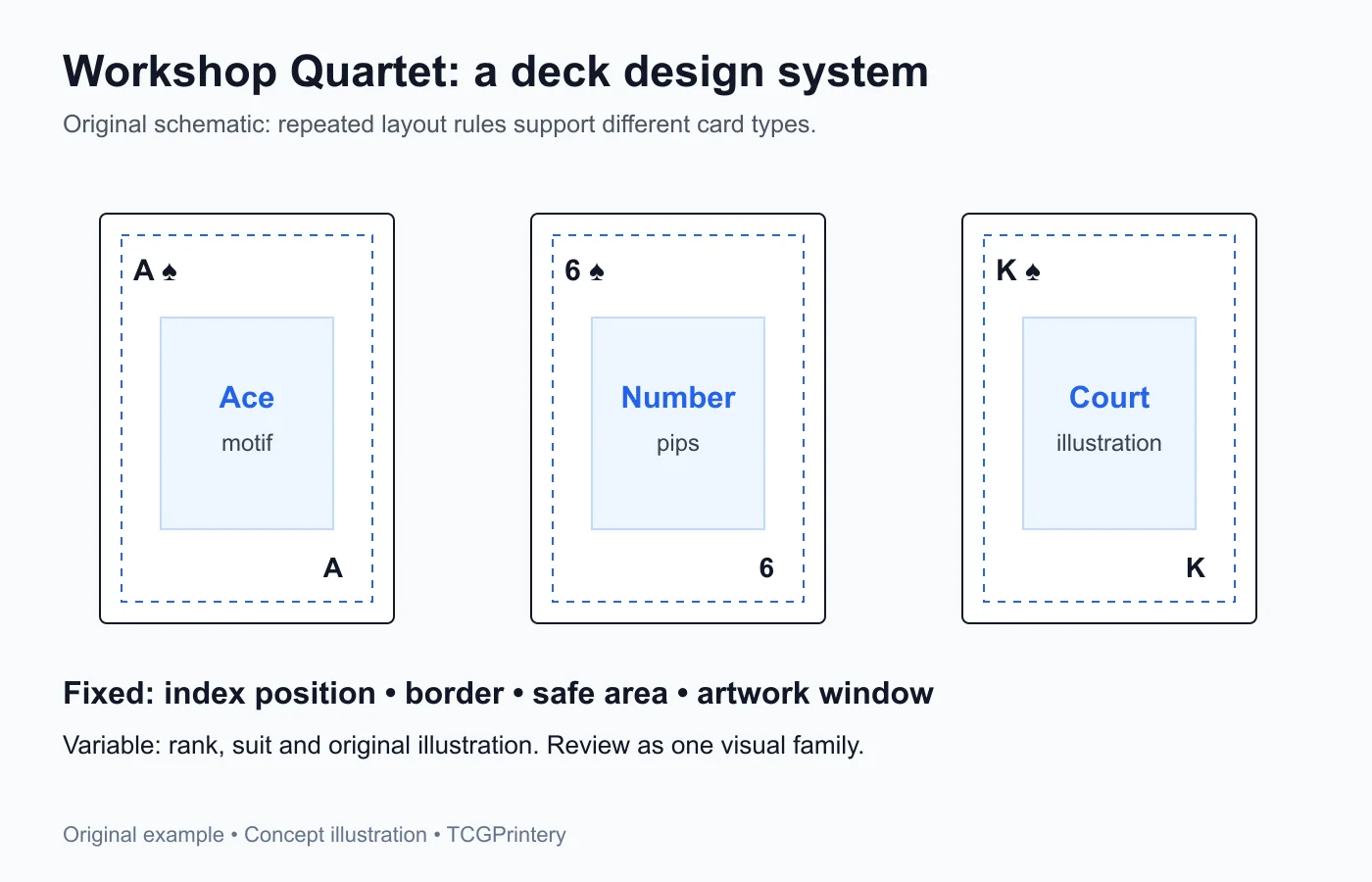
Define the illustration style, line weight, colour palette and border treatment on one page. Decide which parts remain fixed across the deck and which parts vary by suit or rank. This keeps the collection coherent when you return to a card several weeks later.
Workshop Quartet uses fine ink drawings, pale backgrounds and a consistent dark border. Each suit receives its own motif in the illustration area, but every rank index occupies the same position. Start by designing an ace, a number card and a court card. Together they reveal most of the layout problems.
Protect the rank and suit indices
Players often read only the corner of a card while holding a fan. Keep the rank and suit close enough to recognise together, with good contrast against their background. Test the longest rank label and the densest suit symbol rather than approving only a simple ace.
Make a paper mockup at the intended finished size and arrange several cards in your hand. Check whether the index remains visible with normal overlap. Rotate the design to check the opposite corner. These simple design checks are more informative than judging an enlarged image on a monitor.
Give court cards room to breathe
A court illustration can be detailed without filling every available space. Keep faces and meaningful objects away from the edge, and separate them from the rank indices. Decide whether the composition is two-way or intentionally directional before producing the whole court series.
For Workshop Quartet, the ceramicist holds a bowl and the bookbinder holds a small volume. Each object is large enough to recognise at card size. Avoid adding tiny tools simply to make the image busier. Their shapes may disappear in the final print even when they look clear on the source canvas.
Make the back belong to every front
A shared back brings the deck together when the faces are hidden. Use a consistent reverse file for every card and inspect its orientation. If the deck is intended to look the same when turned around, check that the back actually has that symmetry.
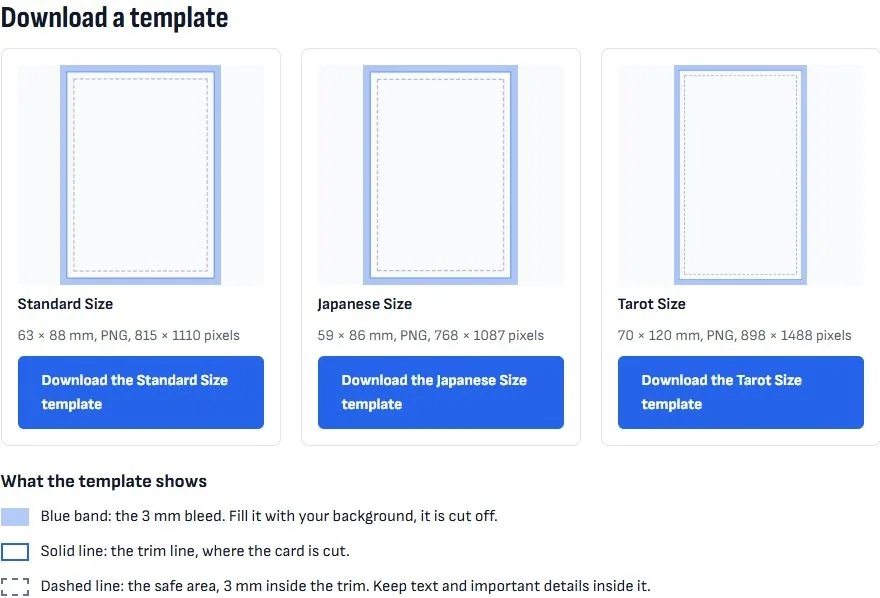
Keep border treatment consistent and allow the recommended safe area around essential details. Fine decorative lines very near the cut edge can make small positional differences more noticeable. Design the reverse as its own composition rather than shrinking a busy front illustration into the space.
Build the artwork on the correct template
Choose the finished format before exporting. TCGPrintery's Standard option is 63 × 88 mm. The card templates and file guide explain the canvas and bleed setup. Keep text and indices inside the safe area while extending background artwork as instructed.
Keep editable source files and export the final images consistently. A spreadsheet or checklist of all ranks and suits helps identify a missing card before import. If the deck includes jokers, give them deliberate designs and include them in the final physical card count. The custom playing cards guide covers the papers and backs for a full deck.
Review a small family of designs together
Compare an ace, a busy number card, two court cards and the back as a group. Look for mismatched borders, drifting indices and inconsistent illustration scale. Print a representative sample on the intended material before committing to the complete collection.
The goal is a deck that feels related from the first card to the last. Set clear design rules, test them on varied card types and keep the useful playing information visible throughout. When the design is ready, see how to print your own playing cards.