Blog
How to Make Trading Cards: Create and Print Your Own Set
Learn how to make trading cards that feel like one set: test one master layout against three very different cards, then print a reviewed collection.
TCGPrintery4 min read
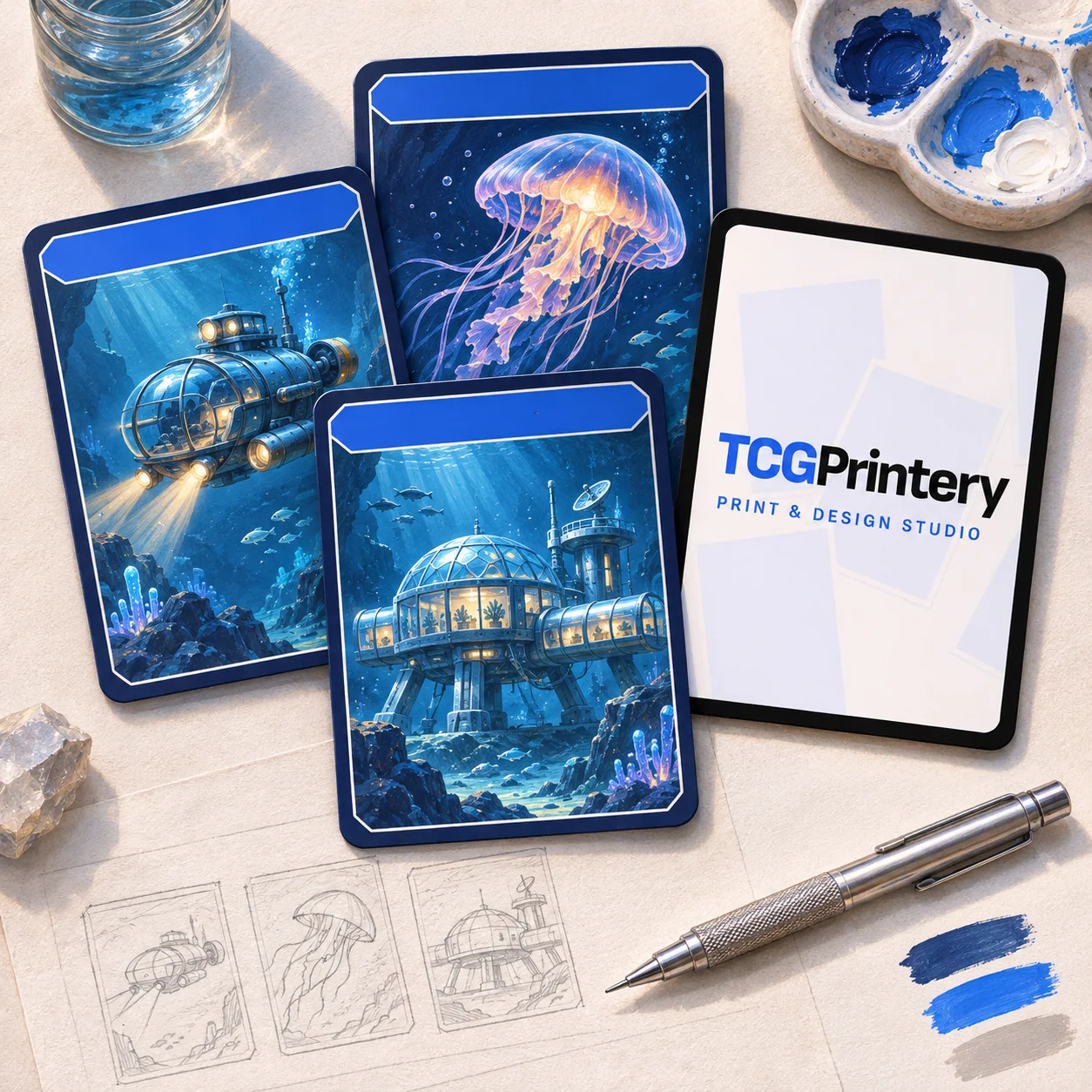
To make trading cards, decide what every card in the set must show, design three very different test cards, turn the layout that works into one master and print a reviewed prototype before the full collection. A set of custom trading cards feels intentional when its differences sit inside a consistent design system, so you do not need to finish dozens of illustrations first. Our fictional deep-sea collection shows the steps from idea to print.
- Define what makes a card part of the set.
- Test three contrasting prototypes.
- Build one master layout.
- Adapt the art inside the frame.
- Review the cards together.
- Print from a complete card list.
Define what makes a card part of the set
Deep Sea Field Notes is a nine-card educational-style collection about an imaginary ocean expedition. It includes vehicles, creatures and locations. Every card carries a short name, an illustration, one descriptive fact and a collection number. The facts are invented for the fictional setting, so the set does not present them as real marine science. Write that shared structure before designing individual faces. It gives you a way to reject attractive details that do not serve the collection and helps a collaborator understand what each finished card must contain. If your cards will be played as a game, the guide on how to make your own trading card game covers rules and balance.
Choose three contrasting prototypes
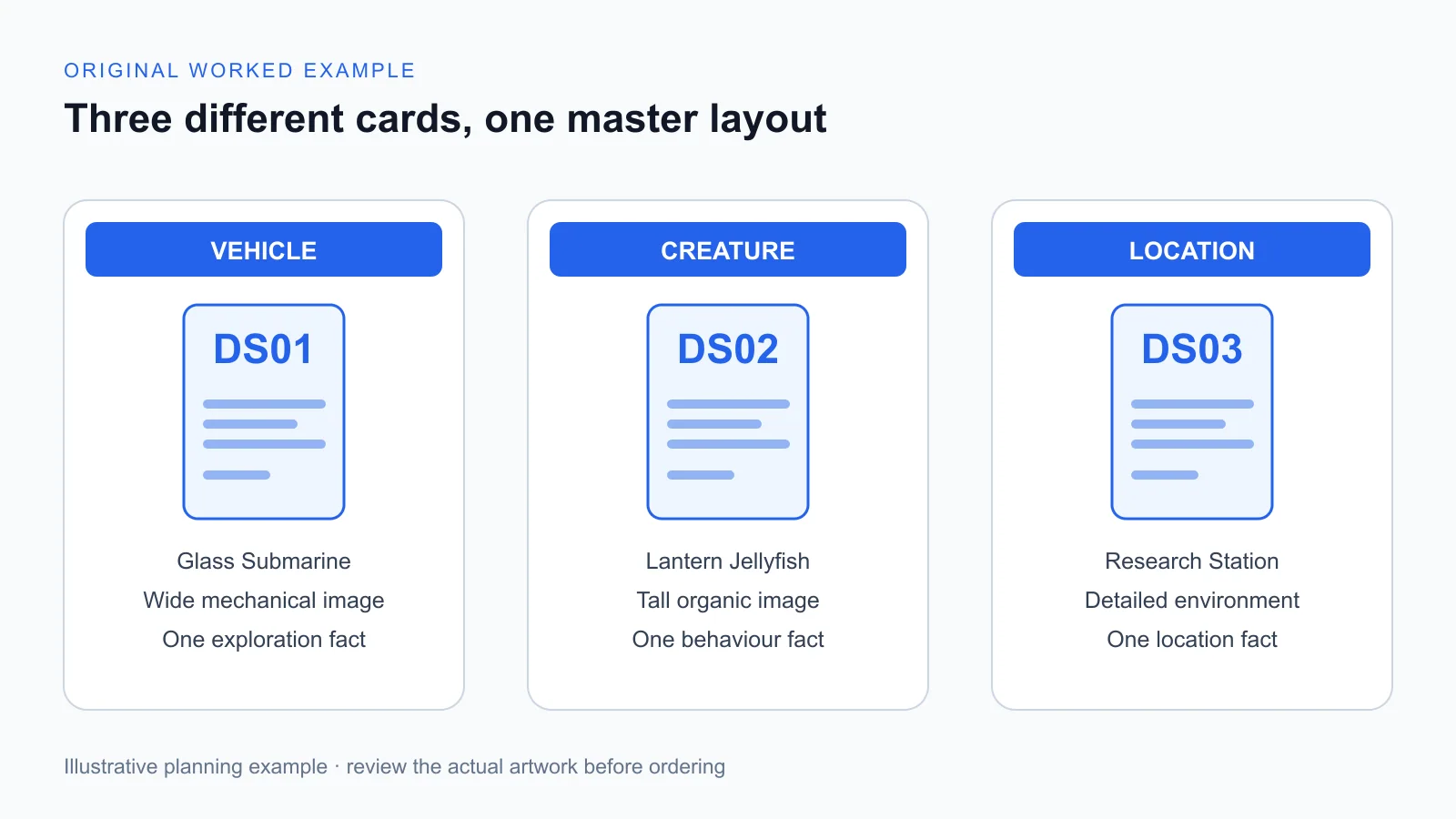
Begin with Glass Submarine, Lantern Jellyfish and Research Station. The submarine is a wide mechanical subject, the jellyfish is tall and delicate, and the station is a busy environment. If all three work in the same image window, you have a more useful test than three nearly identical portraits. Give them stable IDs, DS01 through DS03. Sketch each face roughly before polishing the art. At this stage, the question is whether the information fits and the visual rhythm holds together, not whether every brushstroke is final.
Build one master instead of three exceptions
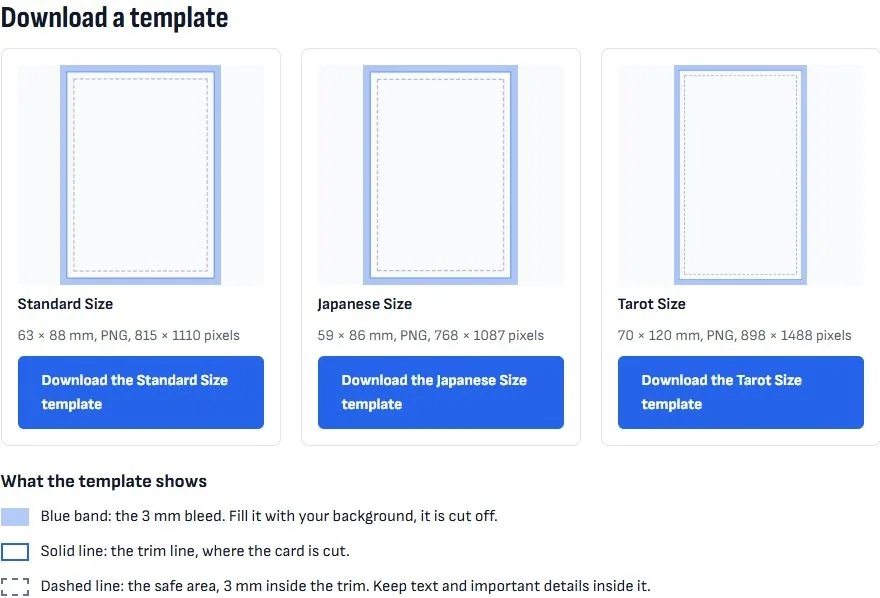
Create fixed positions for the title, image, fact and collection number. Keep a small set of type styles and a shared colour palette. A format template can establish the correct canvas, but the information hierarchy is your design decision. The card size table lists each format in millimetres, inches and pixels. Place the longest title and the longest fact into the master first. If they do not fit, solve the shared layout or edit the wording. Moving individual text boxes freely may rescue one card while making the complete set look inconsistent when displayed together.
Adapt the art inside the frame
Crop the submarine with enough space to understand its shape. Give the jellyfish a clear silhouette against a quieter background. Simplify the station image so the main structure remains visible at card size. These are different art decisions inside the same layout, not reasons to change the frame for every face. Keep important details away from the cut edge and check the file-preparation guidance before exporting. Save the layered source separately from final print files so a later text correction does not require reconstructing the whole illustration.
Review the set as a group
Arrange the three prototypes side by side and compare them at actual size. Check title baselines, image contrast, paragraph length and the location of the collection number. Turn them over and inspect the shared back as well. Ask someone unfamiliar with the project to identify the name and main fact quickly. Their hesitation can reveal a hierarchy problem that you no longer notice after hours of editing. Record any change in the master, then apply it to all three cards before expanding the collection to nine.
Print your trading cards from a complete list
List all nine card IDs with their accepted file revisions and required copies. A collection with one of each design has nine cards; three complete collections require twenty-seven. Add any checklist card as an explicit extra item rather than hiding it among the artwork. Review a physical prototype for readability and consistency before treating the set as finished. When the master and files are ready, choose the format and prepare your cards. A controlled first set leaves you with reusable source files, clear records and a stronger starting point for the next collection.