Blog
Where to Print Custom Cards for the Netherlands?
Plan an original Dutch quartet or group card project, prepare a consistent deck and check the delivery cost and timing for the Netherlands.
TCGPrintery4 min read
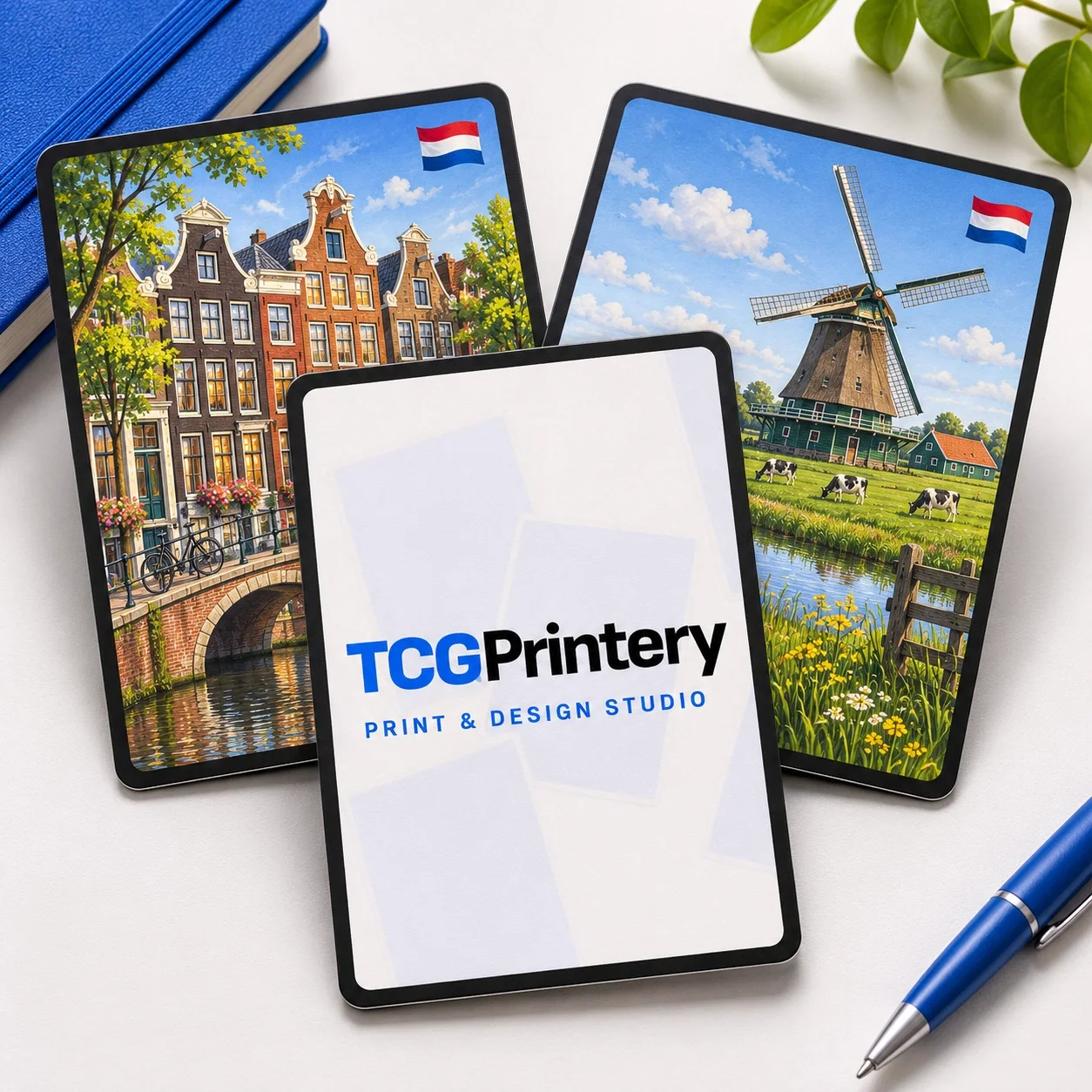
You can print custom cards for delivery to the Netherlands with TCGPrintery, using your own artwork and a project you can review before ordering. A family game, club collection or event set becomes easier to manage when everyone works from one clear card list.
Here is a concrete example: an original Dutch quartet called Nederland in beeld, or “The Netherlands in pictures”. The same planning steps also work for a local history set, a school project or cards for a group of friends.
Begin with one complete quartet
Our example has four matching card faces: De gracht, De brug, De fiets and De windmolen. They share a category heading, blue illustrations and a list of the four cards in the group. Each face highlights its own name, making the relationship easy to see.
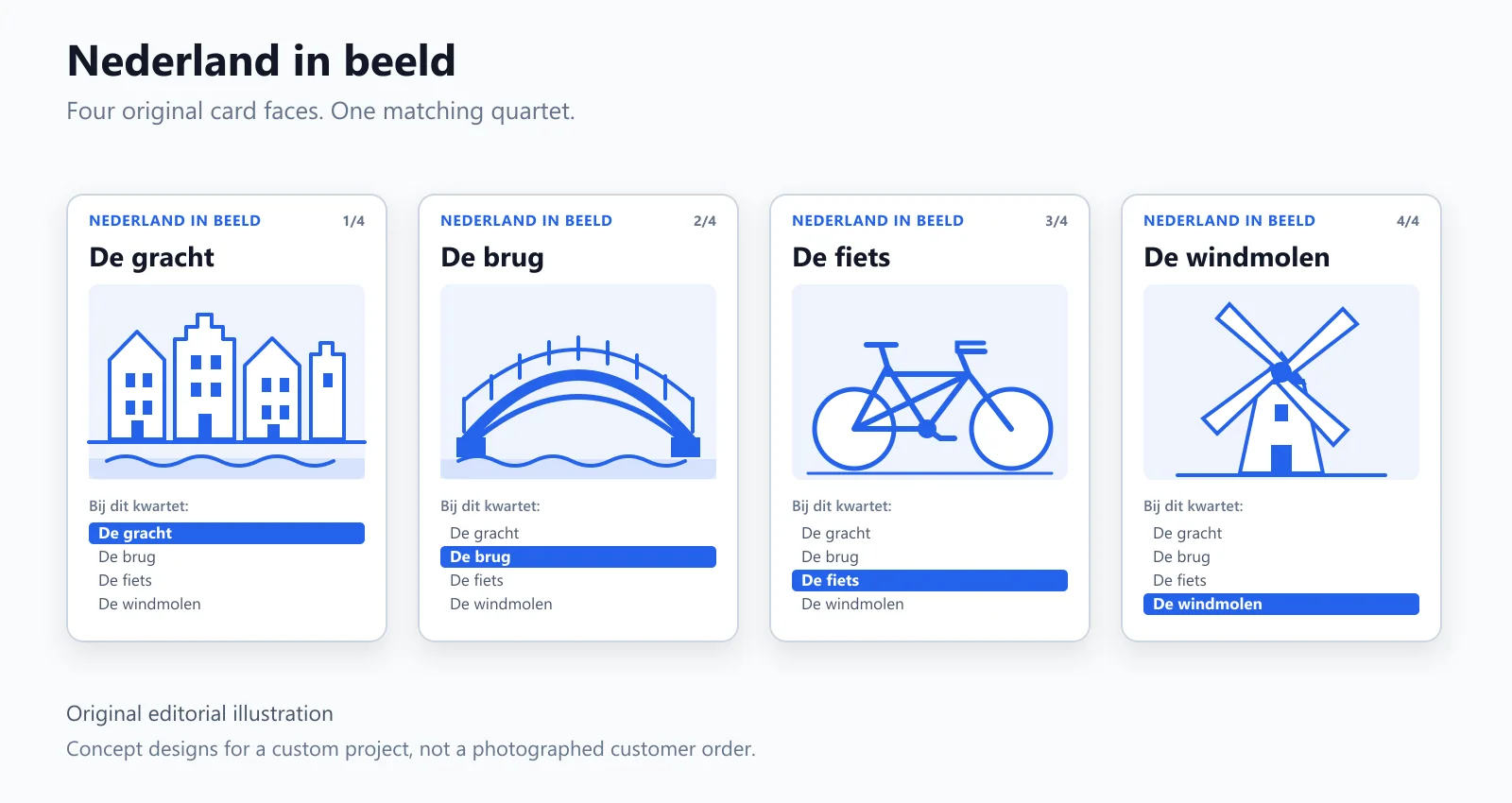
One group is a useful design test. For a larger game, you could create eight groups of four, giving 32 game cards. An additional instruction card would make 33 printed cards per complete set. Those are example counts, not a required deck size.
Give the group one shared card list
When several people contribute artwork, choose one person to maintain the final list. Record each card's group, title, filename, number of copies and assigned back. Keep the spelling and numbering consistent before anyone exports the finished files.
Separate the number of designs from the number of sets. Ten copies of a 33-card project mean 330 printed cards, even though you have only 33 different designs. Check the quantities against your list instead of relying on how many files are in the upload folder.
Use original drawings or material you have permission to print. Agree who will check the Dutch text, who approves the artwork and which version is ready for production.
Choose a size and keep the layout consistent
Standard cards measure 63 × 88 mm. That provides a familiar starting point for our example. Check that the category, card name and group list remain readable at the actual printed size before choosing a more elaborate layout.
Give every card the same text positions and spacing. Leave important details inside the safe area and follow the print-ready files guide for the edges. The Standard workflow supports either one shared back or individual backs, so confirm the intended assignment during review.
Check a sample as a group
Prepare one representative group first. Review its fronts, backs, copy counts and edges in the designer, then inspect a physical sample before committing to all the sets. A screen preview cannot tell you how comfortable the small text is to read during a game.
Put the cards on a table, read them under ordinary room lighting and check whether their titles and categories are easy to distinguish. Note any corrections in the shared list so the same change reaches every affected card.
Check the cost of delivery to the Netherlands
The current shipping policy lists €9.90 per order outside Germany, with free shipping when the cards in the order total €50 or more. For a Dutch delivery, this is a card-value threshold. It is not a minimum card count.
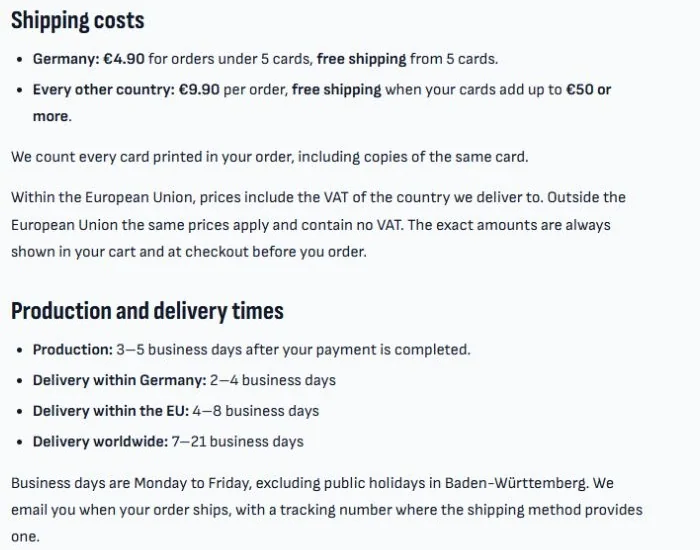
Choose the quantity your group needs, then review the actual card subtotal and delivery charge. Keep any separate packaging or later distribution costs in your own project budget. One delivery to the organiser does not include forwarding individual sets to everyone else.
Leave room before the event
TCGPrintery ships from Germany. Its published estimates separate production, at 3 to 5 business days after payment, from EU delivery, at 4 to 8 business days. Allow additional time for checking a sample, making corrections and distributing the finished cards.
For a club night or school event, agree one delivery recipient and check the complete address. Work backwards from when the cards need to be in people's hands, allowing a buffer rather than treating an estimated delivery window as an arrival guarantee.
Start with your first quartet, agree the full card list and prepare your own project. A consistent set of files and a shared final check give your Dutch card project a clear route to print.